


For decades, the seed inside every date was treated as a burden. Pitting lines produced tons of it, and most of it was discarded or sold as low-value animal feed. That view is now outdated. Cleaned, dried, roasted when needed and finely milled, date seeds become date seed powder: an ingredient with real nutritional value, appealing roasted notes and a growing list of uses in food, beverages, skincare and hair care.
At Date Products Supplier, we see it as both a circular economy solution and a high-value ingredient. It lets us make use of every part of the date, while giving our customers an upcycled raw material with a credible story and real commercial potential.
From waste to resource
The circular economy rests on a simple idea: instead of producing, using and discarding, keep materials in use for as long as possible. In food, this has inspired the upcycled food movement, which turns by-products into new, high-quality ingredients. In the United States, the Upcycled Certified label now recognizes these products, and in Europe, the circular economy is a central pillar of the Green Deal.
Date seeds fit this approach perfectly, because they are far more than waste. A 2025 study found that they contain around 74–80% dietary fiber, 10–13% fat and 5–6% protein on a dry-weight basis, along with a rich mix of polyphenols such as gallic acid, caffeic acid, quercetin and catechin. Seeds even contain higher levels of phenolic compounds and antioxidant capacity than the date flesh itself. That profile is exactly why food, beverage and cosmetic brands are paying attention.
Date seed powder in food and beverages
A caffeine-free coffee alternative
The best-known use of date seed powder is as a coffee-like drink. Roasted and ground, the seeds brew into a dark, aromatic and slightly bitter infusion, but without any caffeine. Research now supports its industrial potential: a 2024 study found that roasted date seed powder works on its own as a caffeine-free drink, or blended with coffee at 10–50% to create reduced-caffeine options that consumers still enjoy. For beverage brands, that opens the door to brewing blends, instant powders, pods and compatible capsules. In the United States, Minus Coffee, developed by the San Francisco food-tech company Compound Foods, already uses upcycled date seeds as one of the main ingredients in its beanless coffee blends.
Chocolate, bakery and snacks
Its toasted, slightly cocoa-like notes pair naturally with chocolate, making it a promising addition to bars, spreads, fillings and coatings. In bakery and snacks, small amounts can enrich cookies, crackers, cereal bars and bread mixes. Studies show that, when the dosage is well managed, it can raise fiber content and antioxidant activity while keeping products enjoyable to eat. Naturally gluten-free, it also suits brands developing free-from ranges.
Date seed ingredients in cosmetics and hair care
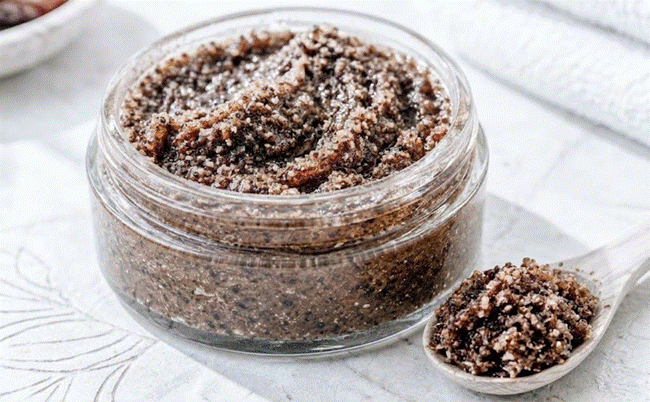
Finely milled date seed powder: a natural, biodegradable exfoliant for scrubs and soaps.
Skincare: antioxidant, brightening and soothing potential
Beyond food, date seed extracts and oil are drawing interest from beauty formulators. Their polyphenols, tocopherols and fatty acids show strong antioxidant activity in laboratory studies, which matters because oxidative stress plays a role in dullness and visible signs of aging. Research has also reported that date seed extract can inhibit tyrosinase, the enzyme behind melanin production, making it a candidate for tone-evening and anti-dark-spot concepts. Other studies point to soothing, anti-inflammatory effects relevant to sensitive skin and after-sun care.
Date seed oil adds a nourishing lipid phase, rich in oleic acid and antioxidants, that may help support the skin barrier, and it has even shown antimicrobial activity in laboratory tests. Most of these results come from lab or early-stage research, so they support innovation and positioning rather than medical claims, and every finished product still needs its own testing.
Hair and scalp care
Date seed oil is mainly made of oleic acid, an emollient fatty acid that helps smooth the hair surface, improve manageability and bring visible shine. That makes it a natural fit for hair oils, leave-in conditioners, masks and pre-shampoo treatments. Its antioxidant compounds can also support scalp comfort in serums and gentle cleansers. Early animal research on hair growth is encouraging, but it remains preliminary and can’t yet be presented as a proven benefit for people.
Clean, vegan and plastic-free
Plant-based, upcycled and free from animal raw materials, date seed ingredients sit comfortably in vegan and clean-label beauty ranges, as long as the full formula is compliant. Finely milled, the powder also makes a natural, biodegradable exfoliant for scrubs and soaps, a welcome alternative to the plastic microbeads banned from rinse-off cosmetics in the United States under the Microbead-Free Waters Act of 2015. The trend has already reached store shelves. For example, SUNDÃRI, a beauty brand co-founded by Christy Turlington, sells a Neem and Dateseed Body Exfoliator, available at major retailers such as Macy’s.
Our circular economy commitment
We source our dates from the oases of Kébili, Douz and the Djerid region in southern Tunisia, and our dates are certified USDA Organic and EU Organic. Tunisia harvested a record of around 404,000 tonnes of dates in the 2025/2026 season, which creates a large and steady supply of seeds. Our dates are processed by partner facilities that we audit and that hold ISO 22000 and HACCP certifications. The seeds removed during pitting are collected, washed, dried, sorted, roasted when needed, then milled and sieved to the right particle size, instead of being discarded. Research shows that each step, especially roasting, affects the powder’s flavor, color and antioxidant activity, and Tunisian teams are increasingly working on adding value to date-palm by-products.
We require lot traceability from the farm to the finished ingredient and have each lot tested by an independent laboratory. Every lot of date seed powder comes with a documentation pack: technical specifications, microbiological and residue testing, allergen and GMO declarations, and the food-safety or cosmetic safety documents required for each use. Our date seed powder and oil are also certified USDA Organic and EU Organic. For our customers, this means an upcycled, traceable and certified organic ingredient.
Looking for a high-value upcycled ingredient with a real story? Contact our team to request date seed powder samples and a technical sheet, or discover our date seed oil.
Sources
Upcycled Food Association: The Upcycled Certified Standard
European Commission (2020): A new Circular Economy Action Plan, COM(2020) 98
Mohamed et al. (2025): Functional dates enriched with date seed powder, New Valley Journal of Agricultural Science
Alkhoori et al. (2022): Biochemical composition and biological activities of date palm seeds, Biomolecules
Shi et al. (2023): Phenolic compounds in date flesh and seeds, International Journal of Food Properties
Dyab et al. (2024): Caffeine-free coffee alternatives from date seeds, Food Technology Research Journal
Compound Foods: Minus bean-free coffee
Food Business News (2025): Food technology startup launches ‘beanless’ ingredients platform
Ranasinghe et al. (2025): Fiber and polyphenol enriched biscuits using date palm byproduct, Journal of Food Science
Ghazzawy et al. (2026): Date palm phytochemistry and applications, a review, Cogent Food & Agriculture
Habib et al. (2022): Bioactivity of date seed extract, Nutrients
Siroukane et al. (2025): Date seed waste in sunscreens, Cosmetics
Alkhalidy et al. (2023): Antimicrobial activity of date seed oil, Scientific Reports
Mrabet et al. (2020): Date seeds as a source of functional oil, Foods
Labyad et al. (2025): Date seeds and hair growth, an animal study, Mediterranean Journal of Pharmacy and Pharmaceutical Sciences
U.S. FDA: Microbead-Free Waters Act FAQs
Macy’s: SUNDÃRI brand page
FreshPlaza (2026): Tunisia’s date harvest reaches an all-time record
Mannai et al. (2023), ICARDA: Valorizing local resources in Kebili